In terms of sociology we see race as more of a social identity. This identity is made of many factors, such as, nationality, religion, language, and traditions. These parts of the social identity are mostly imposed upon a person in their upbringing and from the people who are around them, but a person can choose to shift views in order to build their own "race". In biological terms race can be defined as a person's physical features and who they are similar to. This definition is much harder to pin down due to the sheer variance in the human species, and the differences with much smaller groups of human. Compounding this issue is the fact that there are no single traits that define any race as unique, all traits can be found else where. However, through the use of basic grouping people can be put into broad groups based up skin color, skull shape, and body proportions.
The IAT tests that we took showed us who we favor most in our daily interactions. This was done through positive/negative word associations with the faces of different races. The goal was to see which group was more favored, through faster responses to a positive word. These tests proved to be accurate in that they confirmed the biases that i was already aware that i had. For example, I had a moderate preference of skinny people to fat people. This in no way surprised me, for I know that fat people have always irritated me to no end.
In the area of blacks being better athletes, I think it boils down to training and tradition. In the training aspect one never gets far in athletics without a proper background of good workouts, nutrition, and support. Another factor in athletic success is in tradition, for one's purest expression of their self in in their physical movements and interactions. So if someone always has to fight and scrap in order to get ahead, this will be shown in their athletic performance. This can be seen in American boxing, for as we saw in the most recent video we watched in order to predict the race of the boxing world champ one only has to know the race that is currently on the bottom of the social ladder.
Through this class I had learned to take a slightly less individualistic approach to looking at people, for I have seen how people are a result of the culture in place around them and not just who that person wants to be. For example, I was always angry with the the lowest of the social classes that solely relied of welfare to live, but through this class I can now step back and see how it is the societal system that keeps these people where they are and not just them being resistant to change.
Tuesday, May 24, 2011

Thursday, May 5, 2011
Divide and Conquer - How the Snack Food Came to Power
In "Divided We Eat", Lisa Miller details her dietary habits as well as the eating patterns of the United States as a whole. She does this to show the divide between the rich and the poor, in terms of the foods that they eat. Lisa eats on the upper end of the food quality spectrum, this is done by eating organic, locally grown foods. These foods are also very nutrient rich, and are always fresh. On the other side of the divide, we find the poorest Americans, those who struggle to keep a roof over their heads, and who rely heavily on food stamps. These Americans are pushed into to buying more efficient foods (efficient being cost per calorie). These foods such as pizza, cakes, soda, and potato chips fill the proverbial hole, but lack the nutrition that constitutes a solid diet. This leads to several issues, the first is an entire class of children who are not learning correct eating habits, and as a result they will pass these habits to their children. Another issue with this system is that these children who are growing up eating these junk foods are more than often overweight (or obese) which only leads to further health complications down the road. Lastly, these eating habits do not support local farmers and food producers, only large corporate farming aggregates and big box stores are supported. Miller acknowledges the fact that this disconnect can not be solved overnight, but she does assert that some action must be taken in order to improve the food choices of the poor.
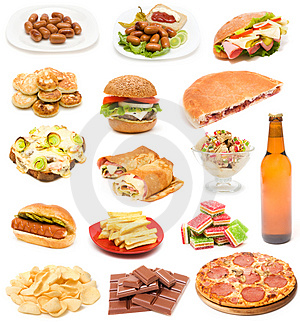 |
| Tasty and dollar-per-calorie efficient, but not healthy at all. |
This same concept was demonstrated in class this week, in the "People Like Us" video. For in Burlington, VT the residents had a large dispute over what grocer was to take the place of a big box store that had failed. The two choices were another chain supermarket, or a co-op market where local farmers and bakers could sell their goods. The main conflict came down to what bread the new store would retail. Residents with lower income were concerned that the co-op would not sell the 99 cent loaves of white bread that they rely on. This shows how the lower income levels of society cannot always afford the most healthy or conscious foods available. This is also a warning, for if the current grocery system is not fixed then we will have severe health and economic problems on our hands (and worse than the health and economic problems we currently face).
Why exactly white bread is not healthy: click on me
A parallel can be seen in this dietary issue and the recent Cairo, IL levee issue. Where several miles of miles of levee were to be destroyed in order to save the town of levee, but the destruction of this levee would flood several hundred thousand acres of MI farmland. However, a state representative was willing to allow Carol to be washed away, only because of its lackluster appearance and low social class citizens. This is similar to the food debate in that upper class citizens are allowing the lower classes to fail, just because they are doing well in their own right.
 |
| Cairo, IL yesterday. |
Subscribe to:
Posts (Atom)